


Crystal Libby

Instructional Designer | Training Facilitator | Technical Writer
Storytelling is my foundation.
I use narratives to transform complex ideas into learning experiences that are meaningful, memorable, and built to last.

Phone: 530-828-1550
Email: crystalalibby@gmail.com
Location: Marina, CA

I am a designated ATD Master Instructional Designer, facilitator, and published author with over ten years of experience across corporate, hospitality, healthcare, and nonprofit settings. I reduced onboarding time by 50% at Pebble Beach Resorts and have trained more than 3,000 professionals through Queer Edge Monterey. Each sample below is grounded in a real organizational need and selected to demonstrate both process and outcome.
Needs analysis, curriculum design, eLearning, and coaching plans
Video tutorials, live facilitation, presentations, and gamification
Standard operating procedures
and job aids
Books, forthcoming titles, and articles
Needs Analysis
I conducted this needs assessment for Monterey County Superior Court's Elimination of Bias Committee to identify what attorneys and judges needed to know and be able to do when working with transgender and gender nonconforming individuals. The findings informed the structure, content, and framing of the full training program.


Curriculum Mapping
I designed this curriculum for the Resort Sales Agent position at Pebble Beach Resorts. The role requires agents to manage complex reservation systems, apply top-down sales strategies, handle objections, and prepare bookings for arrival — all while representing one of the most recognized luxury hospitality brands in the world. I worked directly with subject matter experts to learn the job from the ground up, then wrote all job aids, SOPs, and course activities from scratch. The curriculum spans 15 instructor-led training days followed by a structured five-day shadow week, with each shadow day targeting a specific professional competency.


eLearning
I design self-paced eLearning courses starting with a storyboard, which maps out the content, interactions, and accessibility needs before anything is built. Each course is broken into short segments so learners can absorb one concept before moving to the next. Slides are designed to present information in different ways throughout the course rather than following a single repetitive format. Narration carries detail that would otherwise crowd the screen, keeping visuals clean without losing content.
I strongly advocate for building access needs into the storyboarding process, before a single production asset is created.
The following article explores the strategies I apply across classroom, eLearning, and document formats to support cognitive, auditory, visual, physical, and language access needs:
Read "Hidden Access Needs: What Instructional Designers Often Miss" by Crystal Libby
This sample storyboard slide was built for Gender Inclusivity in Legal Practice, an eLearning course developed for Monterey County Superior Court through Queer Edge Monterey. It shows the planning format I use before development begins, including the on-screen content layout, voiceover script, interaction type, developer notes, and accessibility requirements.

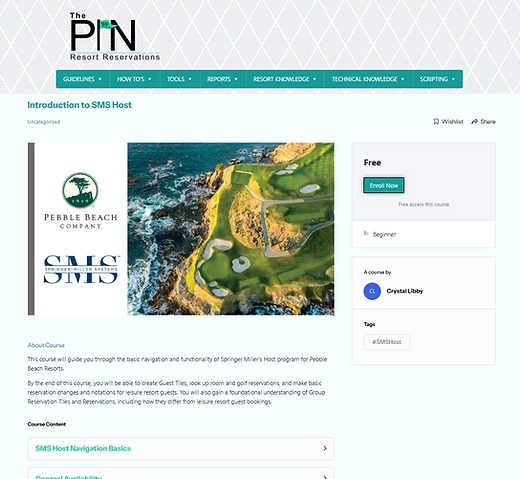
Shown below is the course landing page for a self-paced eLearning course for the Springer Miller property management system with content segmented by user access level and deployed through a SharePoint-integrated LMS.
Evaluations
I evaluate every training program across all four Kirkpatrick levels, connecting participant reaction and learning data to on-the-job behavior change and organizational outcomes.
The reaction survey below was developed for Gender Inclusivity in Legal Practice, a facilitated session for attorneys and judges at Monterey County Superior Court. It represents Level 1 of a four-level evaluation plan that also includes a facilitator-administered observation rubric during scenario practice, a follow-up self-report survey at 30, 60, and 90 days, court transcript review, and a bias complaint tracking system monitored over twelve months following the session.


Coaching Plans
I developed and administered performance evaluations for agents at Pebble Beach Resorts using a coaching plan format that separates observable strengths from areas under active development and ties both to a specific training strategy. Evaluations are grounded in call scoring against a standardized rubric, itinerary accuracy audits, and quantitative metrics including handle time, inbound conversion rate, and revenue per booked call.


